

Text & photos: Johnnie Lippens
Steaks and ribeye are best aged for at least two weeks. The lower the temperature, the longer the meat can age without putting its shelf life at risk.
According to scientific tests, there is no difference in tenderness between dry aging (hanging) and vacuum aging, as long as the aging has gone on for the same length of time. All beef needs to age in the cold for at least a week, but the longer it ages, the more tender it gets. Shelf life does drop, however, if the aging goes on for too long.
For temperatures when you cook the beef later, you can use our beef temperature guide.
Cuts such as chuck, loin
Aging is when the meat, with the help of its own enzymes, breaks down proteins in cells and connective tissue. Aging makes the meat tender, that is, easier to cut and less tough.
I like challenges in gastronomy, and preferably in BBQ and grilling.
I had a whim to try out different dry-aging processes the old-fashioned way, so I bought a 5 ½ lb piece of chuck from Tjolöholm farm in Fjärås
www.tjoloholmsgard.se and 4 ¾ lb of ribeye from the same farm.
When I got home I wiped the meat down very carefully and put the pieces on a rack in a +4°C fridge for 24 hours. This is because the meat has to be dry when you dip it in fat.
At the same time I drove around to most of the shops nearby to get hold of tallow (fat from cattle), which turned out to be completely impossible. I also contacted a few farms and meat wholesalers, and none of them had it at home but could get it in within 14 days. So what do you do now?
I put the question out on Facebook and the BBQ-Lovers grill forum and got a bite within an hour. Lard (fat from the pig) exists, so it was a matter of finding out whether it would work. After consulting a local meat expert, I got to work.
I melted the lard in a saucepan and let it reduce for a few hours, then set it next to the stove and let it cool. I measured the temperature, and when it was at about 26-27°C I got the meat out, pulled on a pair of so-called surgical gloves and cut the chuck in half. The ribeye got to stay whole. Then I carefully washed the so-called S-hooks (meat hooks) with alcohol and hung the pieces on them, one on each. I had decided that the chuck would be aged in lard, while the ribeye would only be dry-aged hanging free.


I weighed all the pieces again, and they weighed basically the same as 36 hours earlier. I hung the ribeye back in the fridge at +4°C.
I dipped the chuck in lard, and between each dip I took it out and let the lard set a little. I dipped it 10 – 12 times, so that the whole piece, the hole where the hook hung and parts of the hook were covered by about 7 - 10 mm of lard. In total this took about 4-5 min, so I counted the temperature difference between the lard and the meat as negligible.
I went out to the aging fridge and hung up all the pieces. Under the meat I put a stainless steel tray that any lard could drip into.
To keep the moisture down I have a small fan in the bottom and have drilled two holes at the top of the cabinet, which normally have two wine corks as plugs.
The humidity in a dry-aging cabinet should be at most 85 %. To be on the safe side I also put in a so-called dry ball. It contains salt and a drip tray that draws in all the moisture. For the first few days I kept an eye on it, and I started the fan and pulled out the plugs for about 30 min in the morning and in the evening.
Now all that was left was to wait…
I checked on it once a week and planned to test the ribeye after 14 – 16 days of dry aging. I wanted to wait 4-5 weeks with the chuck.
Everything looked perfect.
What matters is that the air around the meat is as dry as possible and that the lard-dipped meat is completely covered in lard. Every Monday morning I went out to look at it, and where the lard had come off I brushed on new lard.
After 14 days it was time to grill the piece of ribeye.
It was completely blue-purple-black in color and a bit hard on the surface. I weighed the meat, which now weighed 4 lb The weight loss was 10 oz, which I personally think is a lot. At the same time it makes four perfect pieces for grilling.
I cut the ribeye in half and fired up the grill at max. In the meantime the meat sat out at room temperature for about 90 minutes. I seasoned it with black pepper and sea salt from the grinder beforehand and patted the seasoning into the meat.

When the grill’s temperature gauge showed 275 degrees Celsius at the lid, I put the meat on.
Four lovely pieces of just over 16 oz each.
I counted to 60 (about 1 min), turned the meat, and counted to 30 (½ min).
The goal is rare to medium (a bit more raw in the middle, on the border of medium).
Then I took the ribeye slices off and let them rest on the plates for about 10 - 12 min before we put fork and knife to them. The only other things we ate were a simple salad and hard-whipped unsalted butter.
The reason I let them rest for just over 10–12 minutes is so that the temperature rise stops and the temperature of the meat stabilizes. That means the meat releases as little meat juice as possible.
The meat was incredibly tender, tasted considerably more of meat than usual, and was very juicy, perfectly seasoned and melted gently in the mouth.
One of the best ribeyes I have eaten so far (apart from Kobe ribeye, which I will never forget), and the others thought so too.
Conclusion
Dry aging affected the ribeye quite a lot. The meat became slightly stronger in flavor, that is, it tasted of meat, while the tenderness increased considerably. A weight loss of about 14% is a lot in my personal opinion, as I had expected about 6-7%.
Why it turned out that way I can only speculate.
I can definitely recommend it!
Ribeye dry-aged for 14 days in +4°C cold, from Tjolöholm farm – Fjärås.
Before the aging, the meat is of the best Swedish quality imaginable.

THE CHUCK
After 35 days it was now time to test the lard-dipped chuck.
I started by pulling off as much lard as possible from the meat by hand (wearing surgical gloves).
I weighed them at 5 lb, and the weight loss was about 7 oz, i.e. 8,5 %, which felt normal. The lard method can be compared to the vacuum method, but with fat.

First piece of lard-dipped chuck

Here I have removed the lard coating on the first piece
Second piece of lard-dipped chuck
The last thing I did was rinse off the remaining lard with lukewarm water. I wanted to see any differences in color and what had actually happened.
I also cut both pieces in half.
On the surface there was a black-purple color at the edges, and the rest looked like normal meat.
When I had cut it, it was a lovely dark color in the middle. I felt the meat and found the texture soft, juicy, but still firm.


I cut one of the pieces into larger stew chunks and divided the other into three.
The idea was to grill the three pieces the same way as the ribeye, that is, high heat and fast. They were to be seasoned with only sea salt from the grinder.
The stew chunks were to become something like a Swedish-style braised beef stew made on the grill.
After grilling the first three pieces at a grill temperature of 275°C for about 60 – 70 seconds per side, I let them rest for about 20 min, cut them up and served them with chimichurri made from cold-pressed canola oil, parsley, pressed lime juice, a little finely grated garlic, black pepper and chili.
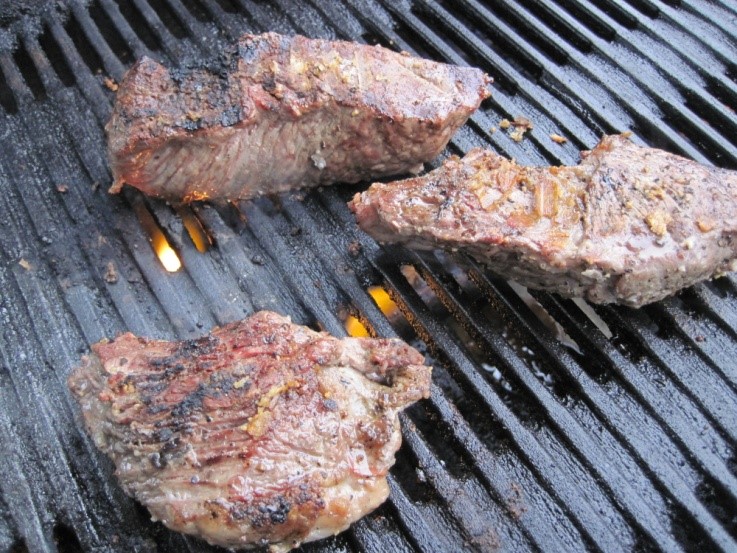

Whoa… whoa… What incredibly juicy and flavorful meat, this was an amazing mouthful. It really tasted the way meat should taste. You could notice a clear difference. Recommended!
Now for the next test. I started up the charcoal grill and put the ash-gray glowing coals in my briquette holders. On top of this I placed a cast iron pot, melted butter and browned the meat, seasoned with salt, pepper and allspice berries crushed in a mortar (the meat was cut as stew chunks), added onion and carrot and browned these lightly.
I added real veal stock that I had made earlier and a splash of 40% cream. The whole thing was topped with a sprig of fresh rosemary.
Then I split the briquette holders and placed the cast iron pot between them. On with the cast iron lid and then the grill’s lid. I left the vent on top open and set the bottom one to just under half open.
After about 5-6 min it started to simmer quite well in the pot and it started to smell like good food. After about 35 minutes I lifted the lids and took two forks to see how far along the meat was. The stew was done.
I took the stew off the grill, and the smell alone made my mouth water. After letting the stew settle down for about 10 min I took out the rosemary sprig. I tested the texture of the carrots, which was perfect, not too soft and not too hard, just right. The stew was served with boiled, pressed potatoes and pressed cucumber salad.
This was without a doubt the best stew I have ever made. The tenderness of the meat was fabulous, and the juiciness was the best we have ever experienced. Absolutely incredible, and what flavors!


Conclusion
Lard-dipping and dry aging is a method that makes the meat extremely tender.
The method is largely similar to vacuum aging in an airless plastic bag.
The fat in the lard encapsulates the meat so that the enzymes can start the aging process in peace and quiet. Lard keeps the air away from the meat itself. The fat in turn is gradually absorbed into the meat to a certain degree (marginal), which probably affects the flavor of the end result. It does not, however, affect the aging process itself.
I let my pieces hang for 35 days, which was perfectly fine. I am super satisfied.
The method is recommended, and I will do it more times myself without hesitation. Chuck for the party in a month is a given, and beef tenderloin and ribeye have gotten a serious competitor. Next time I will try four weeks, three weeks, but also go the other way.
Good luck
Johnnie Lippens