
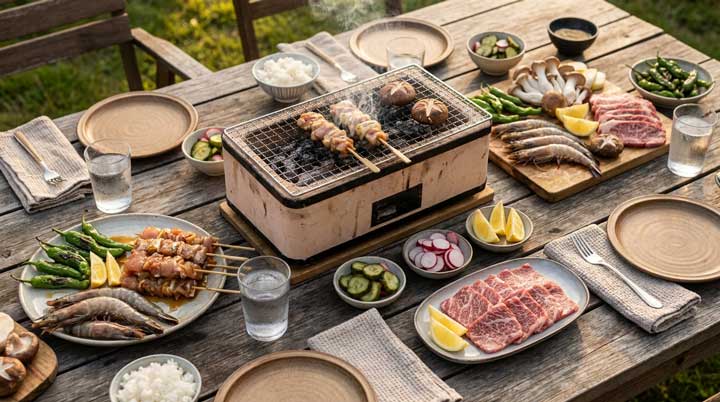

Some grill cultures scream for attention, and then there is Japanese grilling, which just sits there by the embers knowing it already has you. At first it looks almost modest. Small skewers. A narrow grate. A few slices of meat. A little salt. A glossy brush of tare. A tabletop grill that hardly looks capable of anything special at all. But then that thing happens that always happens when someone really knows their fire: the flavor becomes bigger than the surface, the texture becomes more precise than seems reasonable and the whole experience feels strangely intimate. It is not just food being cooked. It is food being cooked close to you, close to the fire, close to the moment.
That is exactly where I think Japanese grilling stands out the most. Not just in the ingredients, not just in the techniques and not just in the classic dishes like yakitori, yakiniku and robata. The big difference lies in the format. In many other grilling traditions the grill stands a little off to the side. In Japanese grilling it is happy to stand in the middle of the experience, literally. Around a table. In front of the guests. At eye level. So that the heat, the aroma and the sound of the food become part of the meal and not just prep work out at the edge of the patio.
That is why I wanted to make this article bigger, nerdier and more useful than a regular overview. Because to truly understand Japanese grilling it is not enough to rattle off a few dish names and say that binchotan is nice charcoal. You have to understand why a small Japanese tabletop grill can change the whole way you cook and eat grilled food. You have to understand why shichirin, konro and the different types of tabletop grills matter so much. You have to understand what gives a yakitori skewer the right feel, why yakiniku is social grilling at its best and why robata almost feels like a language of its own between ingredient, ember and guest.
So that is exactly what we are going to do here. We will go through the history, the culture, the grill types, the fuel, the accessories, the safety, the buying technique, the dishes, the mistakes and how to build this up at home in Sweden without having to live in an alley in Tokyo or have a restaurant kitchen behind you. And yes, you can absolutely use a kamado, kettle grill or gas grill. But this time we let them stand in the second row. The leading role belongs to the tabletop grill, because that is where the soul of Japanese grilling lives.
The first thing to understand: Japanese grilling is as much a format as a flavor
Many Swedish texts about Japanese grilling get stuck straight away on the seasoning. Soy, mirin, sake, sesame, tare. That is relevant, of course, but it is only half the picture. The other half is how the food is cooked, how quickly it is served, how close the guests stand to the grill and how small, precise pieces build a meal in several steps. That is why it goes wrong when Japanese grilling is reduced to “Asian marinades on grilled meat”. It is a bit like saying BBQ is just ketchup on ribs.
Japanese grilling is often built on small portions, quick cooking, repeated rounds and a clear respect for the original flavor of the ingredient. That does not mean everything is spartan or that sauces are unimportant. It just means the sauce is not there to hide anything. It is there to enhance. The same goes for charcoal, heat and grill type. Everything should help the ingredient become clearer, not just darker.
This also makes Japanese grilling feel very modern even though much of the craft is old. Many of us already grill more like this than we might think. We want better control. We want to be able to serve several small things instead of one big piece of meat. We like our guests to be more involved. And we like gear that actually changes how you cook, not just how it looks on Instagram. Japanese tabletop grills fit in there almost dangerously well.
Björn’s take: When people ask me why Japanese grilling feels so special, I usually say it moves grilling from production to presence. You are not standing there “performing food” far away from everyone else. You are almost sitting in the conversation with the embers in front of you.
The history behind Japanese grilling, without making it boring
You cannot squeeze all of Japanese grilling into one straight timeline, because it is several traditions that partly run in parallel. But there are a few important threads that help a lot in understanding why today’s Japanese grilling culture looks the way it does.
The broader Japanese food culture, washoku, has long been shaped by season, regional knowledge of ingredients and a strong sense of balance. It has also been highlighted internationally as a living cultural tradition, not just a collection of recipes. That matters, because Japanese grilling grows out of exactly that logic: ingredient first, technique second, clear ways of serving and a strong connection between food and context.
Yakitori developed into a distinct part of Japanese everyday and nightlife through grilled skewers in small formats, often around izakaya culture where people eat and drink in a more relaxed flow. It is no coincidence that yakitori still feels so social. It is food built to arrive continuously, be eaten hot, shared and discussed while the next round sits over the coals.
Yakiniku follows a partly different track. The modern form in Japan has clear historical connections to influences from the Korean Peninsula during the twentieth century, but developed further in a Japanese direction. That is why yakiniku can feel both familiar and have its own distinct personality. The Japanese expression lies in how the pieces are cut, how the order at the grill is thought out, how the dips are used and how the grilling happens in small controlled rounds.
Robata or robatayaki, in turn, has strong connections to northern Japan and has become especially associated with Kushiro in Hokkaido. It is not hard to see why the style has lived on there. Fresh ingredients from the sea, open embers, small servings and a table where the guests almost share the same air as the grill. It feels rustic, but elegant at the same time.
What unites these tracks is not that everything is grilled in exactly the same way. What unites them is that the fire is used very deliberately, that the ingredients are often cut specifically for their grilling and that the experience around the grill is at least as important as the recipe itself. That is why the tabletop grill becomes so central. It is not just a tool. It is the stage.
Why the tabletop grill is the heart of Japanese grilling
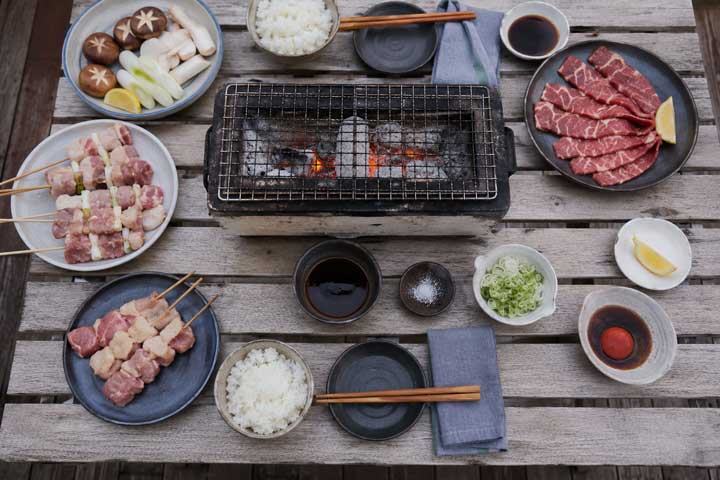
This is the point that is often lost in Swedish articles, and that is a shame, because it is also the most exciting one. When people talk about Japanese grilling at home in Sweden, many immediately start wondering whether they can do it on their regular grill. And the answer is of course yes. But the question should almost be turned around: why are the Japanese so fond of small grills at table height in the first place?
The answer is that the tabletop grill changes the whole rhythm of the meal. It makes the grilling continuous, present and small-scale. You do not have to wait for everything to be ready. You do not have to serve everything at once. You can grill a round of chicken skin, then a few thin pieces of beef, then mushrooms, then a piece of fish, then a new round with tare. It means more conversation, more attention and more precision.
A Japanese tabletop grill also does something to how you choose ingredients. Because the surface is often smaller, you are almost forced to think smarter. Smaller pieces. Better cutting. Fewer but clearer components. Ingredients that actually benefit from high, close heat. That means you quite quickly start cooking in a more conscious way, even when the dishes are simple.
And then of course there is the pure feeling. The embers on the table. The sound when fat drips. The short pause when everyone looks at the same two skewers to see if they are ready. It is an almost ridiculously effective combination of food and atmosphere.
If you only take one thing from this article: Japanese grilling is not primarily a list of Japanese dishes you can cook on any grill. It is a grilling format where the small, hot, controlled tabletop grill is the most authentic way in.
The most important types of Japanese tabletop grills
Now we come to the part I find most fun of all. Because “Japanese tabletop grill” is not one single gadget. It is rather a cluster of grill types with different strengths, weaknesses, materials and uses. If you choose the right type from the start, the whole experience gets better. If you choose the wrong type, it easily becomes expensive, hot in the wrong way and rather frustrating.
Round shichirin
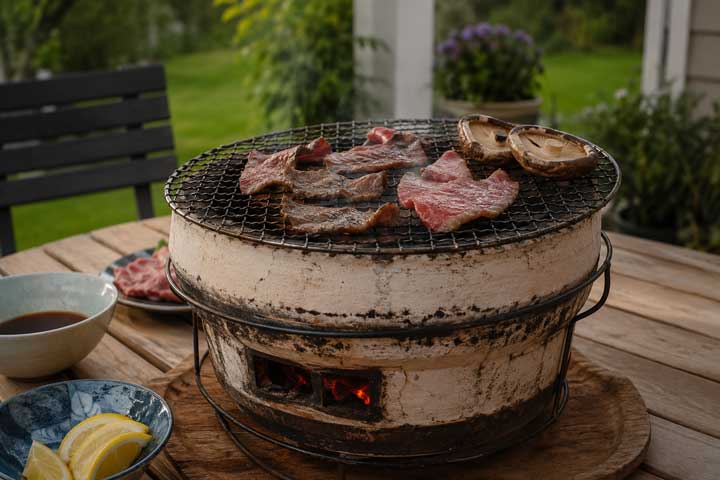
For many people the round shichirin is the very archetype of the Japanese tabletop grill. It is compact, easy to place and often built in ceramic or diatomaceous earth material that holds heat in a very special way. The round shape makes it social and pleasant when two to four people sit close and grill small pieces at an unhurried pace.
This is a grill type that suits yakiniku very well, along with smaller vegetables, thin slices of meat, smaller pieces of fish and general grilling close to the table. It is not always optimal, however, if you mainly want to run long yakitori skewers at high speed, because the round shape can give a little less efficient skewer space than a narrow rectangular model.
The advantages are clear: compact format, high enjoyment factor, good heat retention and a feel that is close to the picture many people have of Japanese tabletop grilling. The disadvantages are also clear: limited surface, a little less flexibility for long skewers and sometimes high sensitivity if the construction is fragile.
Rectangular shichirin
If the round model is the charming social centerpiece, the rectangular shichirin is often the more useful workhorse. Here you get more straight surface, better room for several ingredients in parallel and often a better chance of running both grate and skewers in a controlled way.
This is the model I would most often recommend to someone who truly wants to explore Japanese grilling at home and not just buy a fun gadget for two summer evenings. It works well for yakiniku, very well for vegetables and clearly better for skewers than many round models. It also gives a bit more of a “real grill” feel if you like having several zones in miniature.
Konro, the slim yakitori favorite
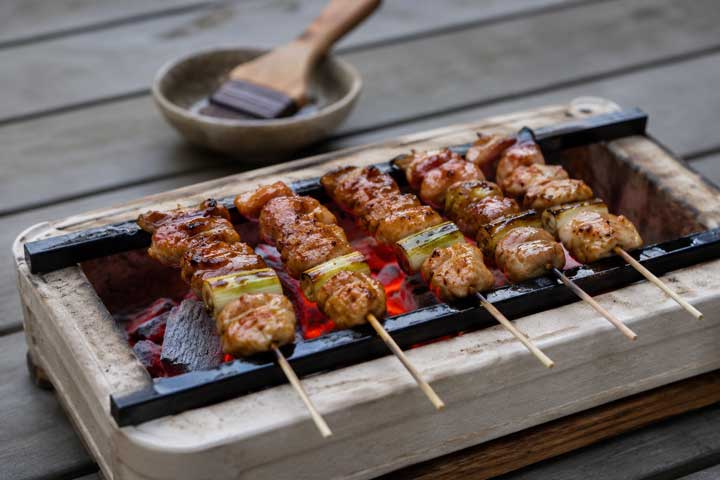
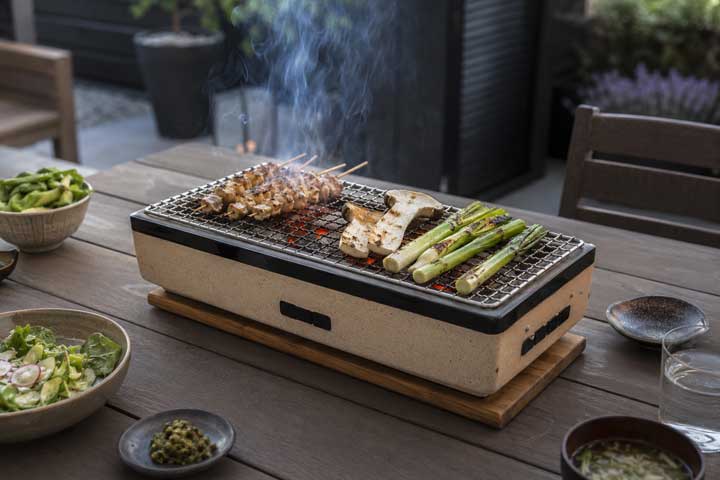
When people dream of real yakitori bars over embers, it is often a konro they are actually thinking of. A konro is usually narrow, elongated and clearly built to work with skewers, especially when you use metal rods or special yakitori bars instead of a regular crisscross grate. That lets the meat lie over the hot zone while the skewers and your hands stay a little cooler out at the edges.
This is the grill type for you who want to get really nerdy about yakitori. It rewards repetitive precision: turn, brush, move, rest, back over the embers. It is not always as versatile as a rectangular shichirin, but for skewers it is hard to beat.
It is also here that you really notice that Japanese grill design is functional in an almost annoyingly smart way. The width, the height and the airflow let you get high heat very close to the ingredient without having to put your hands in the middle of the inferno every time you turn something.
Mini konro and small tabletop konro
There are also small konro- or hibachi-like tabletop models sold for one or two diners, often with a wooden or bamboo base underneath. They are charming, photogenic and can be fantastic for small servings, but here you must not fall too in love with the looks. Many of the smallest models are more for serve-at-the-table grilling of a few pieces than for a whole evening of cooking.
That does not mean they are bad. On the contrary, they can be wonderful if you want to grill a few perfect scallops, a couple of pieces of wagyu, some mushrooms or a quick finishing serving at the table. But they are often worse as a “first and only Japanese grill” if you actually want to learn the technique broadly.
Yakiniku tabletop grills with a mesh grate
Some Japanese tabletop grills are clearly built for mesh grilling rather than skewers. That makes them especially suited to yakiniku, where small pieces of meat, mushrooms, leek, bell pepper or seafood are quickly grilled over a fine grate. Here the eating experience becomes very social, because each guest can put pieces on and take them off at their own pace.
This is a category that is very interesting for Swedish homes. It does not require going all in on yakitori nerdiness from day one. You can basically invite people over for a Japanese grill night, lay out thinly sliced meat, mushrooms, dipping sauces, rice and pickles and be up and running quite quickly. It is a low threshold but a high wow factor.
What is often called hibachi in the West
Here it gets a bit messy, because the word hibachi is used quite sloppily in many Western shops and guides. In practice people often mean small Japanese-inspired tabletop grills, but the product category is not always correctly named. For a Swedish buyer the most important thing is not to be the language police, but to understand what you actually get: shape, material, grate solution, air control, distance to the embers and how the grill is meant to be used.
So when you see “hibachi” in a shop or on a product list, I recommend always looking behind the name. Is it actually a round shichirin? A narrow konro? A decorative mini grill with no sensible airflow? That is where it is decided whether it is a real buy or just a nice little heat box.
The difference between shichirin and konro, for real
This is one of the most common confusions, so let us sort it out properly. In practice the terms are sometimes used a bit loosely in different markets, but as a griller you gain a lot by thinking like this:
- Shichirin is the broader category of small Japanese tabletop charcoal grills, often in round, square or rectangular form.
- Konro often refers to the narrower, more elongated grill type that is especially appreciated for skewers and close, concentrated grilling.
It means you may see products where the words are mixed, and sometimes rectangular models are sold as both shichirin and konro depending on the retailer. But as a user the difference is simple: if you mainly want to cook yakiniku and mixed table food, think shichirin. If you mainly want to run yakitori and work methodically with skewers, think konro.
Rule of thumb: If the grill looks like it wants to hang out with skewers, you are close to konro land. If it looks more versatile for small pieces on a mesh, you are more often in shichirin land.
The materials that make such a big difference
A big part of the magic of Japanese tabletop grills lies in the material. Many models are built in ceramic, diatomaceous earth or other heat-retaining constructions rather than thin metal. That is not just an aesthetic matter. It affects how the heat is held, how quickly the grill reacts, how evenly the embers work and how close you can get without everything feeling out of control.
Diatomaceous earth and the diatomite feel
Many modern shichirin models are built in materials often described as diatomaceous earth, that is, some form of diatomite- or mineral-based structure. For the griller that mainly means two things: good insulation and a special, stable heat character. The grill does not just get hot. It holds the heat in a calmer and more concentrated way than very thin metal does.
This is also one of the reasons the food often gets that nice surface so quickly. The heat becomes concentrated without the grill itself feeling like an aggressive oven monster. But there is a downside: some models are more sensitive to knocks, moisture and rapid temperature shock. That is why care and safe use matter more than on a regular thick steel grill out on the patio.
Ceramic models
Ceramic tabletop grills often have much the same appeal as a kamado in miniature: they hold heat nicely, they feel solid and they make the grilling itself a bit more ceremonial. The advantage is feel and stability. The downside can be weight, brittleness and price.
Metal models
There are also more metal-based Japanese-inspired tabletop grills. They can be more durable, sometimes cheaper and easier to move, but they do not always give the same heat retention or the same character as the more classic materials. For some users it is still the right path, especially if the grill will be used often outdoors, transported or serve more as a robust work tool than as a mood builder.
Interior parts, brick and airflow
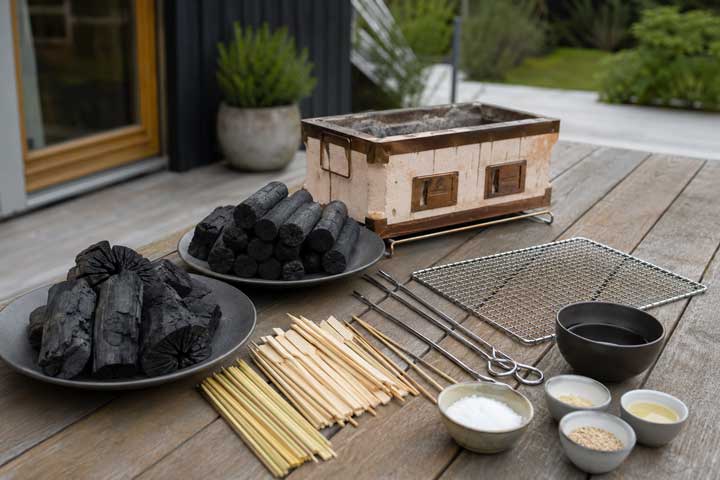
On more thoughtfully designed models you quickly notice that it is not only about the outer shell. Interior brick or brick-like parts, iron grates inside the grill and smart venting underneath make a big difference. Konro grills for skewers in particular are often built to lift the charcoal, improve airflow and keep the ash away from the actual ember zone. It is details like these that make a grill feel professional in use, even if it is small.
Fuel: binchotan, regular charcoal and what you should actually start with
Now we come to yet another point where it is easy to get a little too romantic. Yes, binchotan is fantastic. Yes, it has an almost mythical standing in many yakitori contexts. But that does not mean you have to start there to get a good experience.
Why binchotan gets talked about so much
Binchotan burns long, hot and relatively clean. It gives a dry and distinct ember that is very well suited to close grilling of small ingredients. For yakitori it is especially attractive because you want a crust quickly without the grill tasting heavily of soot or bad charcoal.
When you watch really skilled yakitori masters work over binchotan, you also understand why it has become so associated with the craft. The heat feels almost surgical. But that is exactly why it can also be a bit unnecessarily hard for a beginner, both financially and practically.
Should you start with binchotan?
My honest recommendation is: not necessarily. If you are new to Japanese grilling, it is often smarter to start with a good, natural, high-quality charcoal and learn the rhythm of the grill first. Once you understand airflow, amount of fuel, height, turning and serving logic, you get much more out of binchotan when you try it later.
What you want to avoid
Cheap, crumbly and sour charcoal is a really bad idea in small tabletop grills. Poor fuel quality shows up much faster there than in a larger kettle grill with more distance between embers and ingredient. If you still want to read more about wood, the feel of charcoal and how smoke aromas behave, our guide to smoking wood is still very useful as a flavor reference.
How I think about different levels
- Beginner: good natural charcoal, learn the grill.
- Enthusiast: try Japanese or Japanese-inspired quality charcoal in smaller amounts.
- Yakitori nerd: that is when binchotan starts to get really interesting.
How to choose the right Japanese tabletop grill: the real buying guide
Here I think many guides get too slack. They say “choose according to your needs” and then leave the reader with more questions than answers. So let us do it properly instead.
Choose first by how you want to eat, not by how the grill looks
The first thing to ask yourself is not whether the grill looks Japanese enough. Ask yourself how the evening around the grill should work.
- Do you want to sit two people and grill small luxurious bites at an unhurried pace? Then a smaller round or compact model can be perfect.
- Do you want to host three to four people for yakiniku and let everyone grill in rounds? Then a rectangular shichirin is often smarter.
- Do you mainly want to learn yakitori and really run skewers in earnest? Then you should look at a narrow konro or a model with clear support for yakitori bars.
Size matters more than many think
A grill that is too small quickly becomes more frustrating than romantic. That applies especially if there are more than two of you. At the same time the grill should still feel like a tabletop grill, not like a regular outdoor grill that happened to get shorter. For Swedish home use I often find the “middle format” most interesting: big enough to cook real food, but still clearly social and close to the table.
Look at the grate or the bars
This is a classic miss when buying products. People look at the outer shape but completely miss how the grill is actually meant to be used.
- Mesh or grill grate: better for yakiniku, small pieces and mixed grilling.
- Yakitori bars or rods: better for skewers, more control and the right working angle over the embers.
It is concrete, easy to understand and really affects the user experience.
Check air control and the charcoal bed
A really good Japanese tabletop grill is not just a bowl where you put charcoal. Air control, charcoal holder and interior construction decide how easy it is to get the right heat and how easy it is to hold it. If the grill has no sensible vent or a poor charcoal support, everything becomes harder than it needs to be.
The underside is not a detail
When a grill is going to stand on the table, the surface underneath suddenly becomes very important. Many better models come with a wooden or bamboo base, heat shields or clear instructions to use protection underneath. That is not decoration. It is absolutely essential if you want to avoid a very expensive lesson on your tabletop.
How much durability do you actually need?
If you know you will carry the grill in and out often, use it in different places and perhaps not always be the gentlest person on earth when something needs to be moved, then it is worth weighing durability quite heavily. Some grills are fantastic once they are in place, but do less well with a hard life.
My recommended order of priority
- Use: yakitori, yakiniku or all-round.
- Size according to how many people will actually use the grill.
- Grate/bars and airflow.
- Material and durability.
- Price.
Yes, price comes last here. Not because budget is unimportant, but because a cheap grill that does not fit the way you use it ends up expensive anyway.
My buying recommendation depending on what kind of griller you are
For the curious home griller
Choose a rectangular all-round shichirin with a mesh or flexible grate. It gives you the best chance of trying yakiniku, vegetables and simpler skewers without locking yourself in too hard.
For those who already know yakitori is the goal
Go straight for a konro or a model built for skewers. You will probably want to switch later anyway, and then the first purchase mostly feels like a stopover.
For those who want the experience at the table more than the nerdiness of the grilling surface itself
A round shichirin or a compact good-looking tabletop grill can be exactly right. A lot of it is about atmosphere, small grilled servings and bringing the format into your social life at home.
How a Japanese grill night differs from a Swedish grill dinner
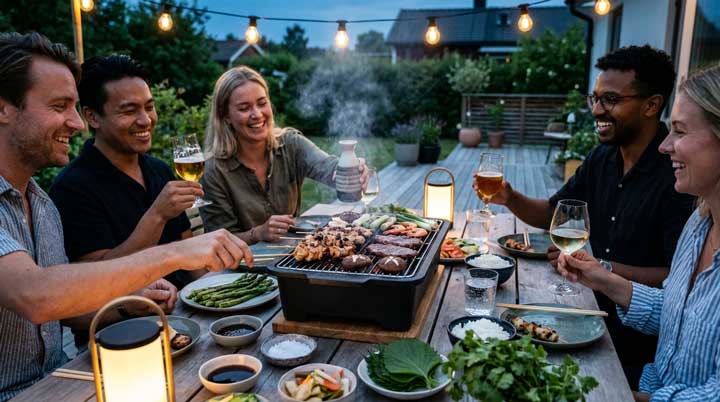
This is really the whole point of why the tabletop grill is so important. A classic Swedish grill dinner is often centered on one main dish that is finished at the grill and then carried to the table. Japanese grilling, especially in tabletop format, works more like a series of small highlights.
First perhaps a few shishito peppers or mushrooms. Then thinly sliced beef that gets exactly the right color. Then a couple of chicken thigh skewers. Then some leek. Then a new round with tare. Then maybe a piece of salmon or mackerel. Everything is eaten while it is still singing a little from the heat.
This means you almost automatically get better at timing and serving. You stop thinking “when is everything ready?” and start thinking “what is best right now?”. It is a very pleasant way to cook, and quite a hard way to go back from once you have gotten used to it.
Yakitori in depth: why the skewers are bigger than they look
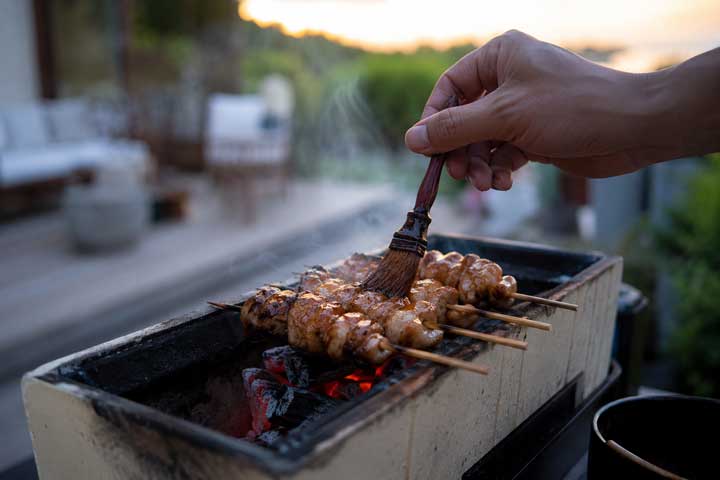
Yakitori looks simple until you try to make it really good. Then you quickly notice that it is a discipline where almost everything matters: the cutting, the fat distribution, how tightly you pack the skewer, how much air there is between the pieces, when the salt goes on, how reduced the tare is and exactly how far from the embers the ingredient sits.
The nice thing is that a konro or narrow tabletop grill makes this kind of precision much more natural. The skewers lie straight, the heat hits clearly and you stand close enough to act right away when the surface starts to look right. On a larger grill it works too, but it is easier to lose that fine motor control.
Parts of the chicken and why they behave differently
Chicken thigh is beginner-friendly and tasty almost however you do it. Skin is fattier, more delicate and loves high heat but requires attention. Breast fillet can be fantastic but punishes carelessness right away. Heart, liver and other cuts require more knowledge and more courage, but that is also where much of the charm of yakitori as a culture lies. It is a cuisine that takes the ingredient seriously enough to use more than just the most convenient parts.
Shio or tare?
It depends not only on what you like, but on what the ingredient wants. Some parts shine with salt because the clean flavor then gets to stand in the center. Others win with tare, especially when the texture needs umami depth or when small fattier pieces do well with a little sweet-salty lacquer.
Why konro is so good for yakitori
With a narrow grill you can let the meat lie over the intense embers while the skewer itself gets less heat stress. That lets you work faster and more relaxed. It sounds like a small detail until you have stood with regular skewers over an open grill and tried to turn them without getting a grilled fingertip as a bonus.
Yakiniku in depth: the social grilling format more Swedes should discover
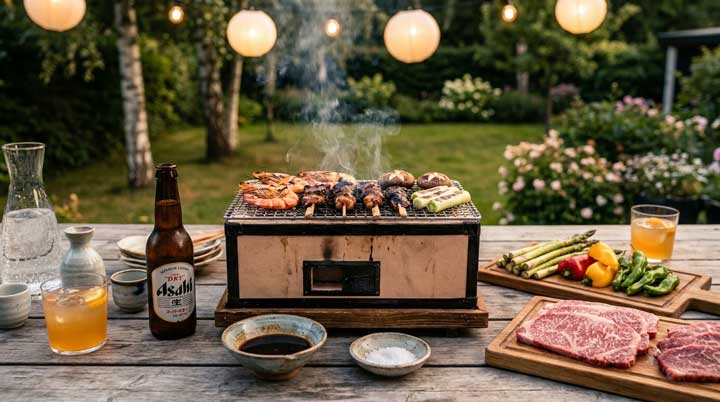
If yakitori is the craftsman’s skewer world, yakiniku is the social table world. Here the grill itself comes into the middle of the company and everyone can take part. It becomes easier to grill exactly as much as you want to eat, easier to try several different pieces and easier to build the meal around small variations instead of one big project.
It suits Swedish home life very well. You can lay out thinly sliced beef, pork, chicken, mushrooms, leek, bell pepper, dipping sauces, rice, pickled cucumber and lettuce leaves and let the evening be built from small decisions. Want another piece? Great. Want to put it on with salt first? Do it. Want to dip the next one in tare or a tangy dressing? Go for it.
Ami-yaki and the teppan way of thinking
An important detail in yakiniku is that mesh grilling and plate grilling give different results. On a mesh or grate more fat drips off, the surface gets a little drier and more grilled. On a smoother surface more moisture stays in. For home use, mesh or grate grilling on a Japanese tabletop grill is usually the most interesting route because it gives a clear contrast between surface and juiciness.
Which ingredients work best?
Thinly sliced ribeye, well-marbled strip loin, flap steak in thin pieces, pork belly, chicken thigh, shiitake, enoki, king oyster mushrooms, leek, onion, zucchini and bell pepper are all very rewarding. Here it matters more that the ingredients are cut right than that you have fifteen different marinades out.
The serving logic
Yakiniku works best when everything around the grill helps the meal move forward. Small bowls, clear dips, rice ready, something fresh on the side and a discipline about not overcrowding the grate. Put on too much at once and you turn elegant tabletop grilling into mildly stressful meat logistics.
Robata and robatayaki: the open fire with the ingredient at the center
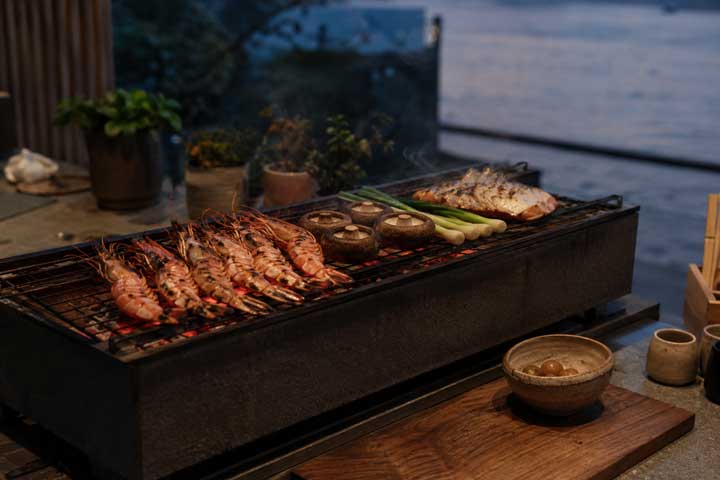
In many ways robata is the link between the Japanese tabletop grill way of thinking and a more traditional open-fire feel. Here there is often more focus on fish, seafood, vegetables and fine ingredients that get to speak clearly. Robata can be rustic without getting sloppy. That is perhaps what I like most about the style.
In a home version, robata can be anything from using a rectangular shichirin to building a serving logic where small grilled dishes arrive continuously from a narrow tabletop grill. Think fewer marinade experiments and more ingredient, salt, heat, maybe a little citrus, maybe a light glaze but nothing that takes over.
I find robata especially interesting for Swedish grillers who already like fish and seafood but want to get away from everything having to bathe in butter, garlic and dill to feel complete. Here there is a more precise and ingredient-focused way to grill the things of the sea.
What to serve to make the whole thing feel truly Japanese
Japanese grilling is not only about what is on the grate. It is also about what is around it and holds the meal together. That is where many people make the mistake of thinking too heavy. They grill nicely and then lay everything out with big potato gratins, rich sauces and sides that belong at a completely different table.
If you want the right feel at home, think like this instead:
- Steamed rice or simply seasoned rice as a neutral base.
- Pickled vegetables for acidity and freshness.
- Lemon or other citrus on the side.
- Small dipping bowls with tare, a salt mix or a lightly tangy sauce.
- Grilled vegetables that feel clean and clear, not overworked.
It does not mean everything has to be minimalist. It just means the plate should help the grilling, not fight it.
How to use a Japanese tabletop grill safely and sensibly
This is not the sexiest part of the article, but it is one of the most important. A small Japanese charcoal grill on the table is fantastic, but it requires respect. Not fear, but respect.
Ventilation first
Charcoal grills of this type should be used in well-ventilated environments. Many models and instructions are very clear about this, and it should be taken seriously. The Swedish “we’ll open a window a crack” is not a strategy. If you do not have enough ventilation, use the grill outdoors.
Protect the surface
Never place the grill directly on a sensitive surface without heat protection. A wooden base, bamboo board, stone or other proper support is not overkill. It is part of the whole system.
Do not move the grill while it is hot
Many materials in Japanese tabletop grills dislike quick movements, knocks and temperature shocks. Let the grill cool down calmly. Do not pour water on a hot ceramic or mineral-based grill in a panic unless you absolutely must for safety reasons. It can be a quick way to crack something that was not cheap to begin with.
Do not build too dense a charcoal bed
A common beginner mistake is believing that more charcoal always gives a better grill. In small tabletop grills it is often the opposite. Too dense a bed can give worse airflow and messier heat. Better to learn how the grill wants to breathe.
Can you use a kamado, kettle grill or gas grill instead?
Yes, absolutely. And I would be dishonest if I said otherwise. You can make fantastic yakitori skewers on a kettle grill, you can make superb robata-inspired food on a kamado and you can run very nice yakiniku logic on a gas grill with good heat zones.
But. There is a big but here. You do not quite get the same experience. You do not get the same closeness to the table, the same small intense format, the same feeling of the food coming into being in the conversation. And that is exactly why I think Japanese tabletop grilling deserves to stand at the center here, while larger grills can be plan B or plan C.
If you are unsure about the basic technique around charcoal and lighting, it is still wise to start by learning to light your grill the right way. Good fire is still good fire, whether the grill is small or large.
How I build a first Japanese tabletop grill night at home
If I were to put together a first evening for someone who wants to feel that this actually works at home in Sweden, I would do it like this:
- A rectangular tabletop grill in a reasonable middle format.
- Good natural charcoal, not necessarily binchotan the first time.
- Two types of protein: chicken thighs on skewers and thinly sliced beef.
- Two to three vegetables: shiitake, scallions and zucchini or eggplant.
- One tare, a bowl of fine salt and lemon wedges.
- Rice, pickled cucumber and possibly a simple cabbage salad.
That setup lets you feel both the yakitori and the yakiniku logic without it becoming too much of a project. You learn the speed of the grill, you notice what happens with different ingredients and you get a real table experience instead of a theme dinner that only dressed up a little.
Common mistakes when people buy a Japanese tabletop grill
They buy too small a grill
This happens all the time. You fall in love with a cute little model and then realize that two people barely have room for one round each at the same time.
They buy by picture, not by use
The grill looks fantastic in the product photo, but once you want to run skewers it turns out the grate is wrong, the airflow is poor or the surface is too impractical.
They underestimate safety and the surface underneath
It is easy to think “it is so small”. Yes, and that is exactly why it sits close to the table, hands, place settings and people. Small grills do not require less care. They often require more.
They go all in on binchotan before they know the grill
It is a bit like buying a racing bike before you have learned to shift smoothly. Sure, it can work, but it is rarely the smartest start.
They try to cook too much food at once
Japanese tabletop grilling wins on flow. If you try to make the whole dinner in one giant batch at once, the point disappears.
Why Japanese grilling works so darn well
It is about concentration. Small pieces give lots of surface per bite. High, close heat gives quick caramelization and clear texture. The tabletop format means the food is eaten when it is at its best. Salt and tare are used more as precise tools than as big blankets over everything. And the whole meal is built in small steps where it is easy to adjust, improve and follow the rhythm of the ingredient.
That is also why Japanese grilling feels so educational. It rewards attention. Learn this world and you almost automatically get better at all other grilling too. You cut smarter, serve smarter, season smarter and see earlier what is about to go right or wrong over the embers.
And maybe most important of all: it makes grilling more fun. Not bigger, not more macho, not more competitive. Just more fun. More present. More alive. More “now we are grilling together” than “wait, I’m over at the grill for another forty minutes”.
FAQ about Japanese grilling and Japanese tabletop grills
Which Japanese tabletop grill is best for beginners?
A rectangular all-round shichirin is often the best start. It handles yakiniku, vegetables and simpler skewers without locking you in too hard.
What is the difference between shichirin and konro?
Shichirin is the broader category of small Japanese charcoal grills, often round or rectangular. Konro is more often narrower and more optimized for skewers, especially yakitori.
Do you have to use binchotan?
No. Good natural charcoal goes a long way in the beginning. Binchotan becomes most interesting when you really want to dive deep into yakitori and get maximum control and character from the grill.
Does a Japanese tabletop grill work indoors?
It depends entirely on ventilation and model, but the basic rule for home use is to be very careful and in practice prefer outdoors or very well-ventilated spaces. Charcoal and poor ventilation are nothing to play with.
Which model is best for yakitori?
A narrow konro or another model with support for yakitori bars is usually best if skewers are the main goal.
Which model is best for yakiniku?
A round or rectangular tabletop grill with a good mesh or grate usually suits best, especially if several people will sit and grill small pieces continuously.
Can I recreate the same feel on my regular grill?
You can cook very good Japanese-inspired food on your regular grill, but you do not quite get the same closeness to the table. It is exactly the tabletop grill that makes the experience so special.
What should I cook the first time?
Chicken thigh skewers, thinly sliced beef, shiitake and scallions make a perfect first track. It is easy to succeed with and quickly shows what the grilling format can do.
The nice thing about Japanese grilling is that it does not try to impress by being bigger than life. It wins on closeness, precision and feel. And once you are sitting there with the embers in front of you, a few skewers heading toward the right surface and a whole evening coming in small, warm servings, it feels pretty obvious why so many get hooked. This is not just another kind of grilling. It is another way of spending time together around grilled food. And that is exactly why it is worth going all in.